AI Doesn’t Read Dashboards… and That Changes Everything for Databases

A bank executive opens a fraud dashboard in Microsoft Power BI.

Losses by region, chargeback ratios, transaction velocity trends and a heatmap of anomalous activity. The numbers refresh within minutes. Data flows out of the system of record, is reshaped and aggregated, then presented for interpretation.

This is contemporary analytics: fast and operationally impressive. But it remains interpretive. It explains what is happening, while intervention occurs elsewhere – inside a fraud model embedded in the execution path, deciding in milliseconds whether money moves or an account is frozen.

Reporting systems describe what has already occurred. Even when refreshed every few minutes, they are retrospective. Inference systems are anticipatory. They evaluate the present in order to shape what happens next.

For two decades, enterprise data platforms were built around a deliberate separation between systems of record and analytical platforms. The system of record handled revenue-generating transactions; analytics operated on copies refreshed hourly or even every few minutes. Latency narrowed, but the boundary remained.

AI systems do not consume summaries, however fresh. They make decisions inside the transaction itself. A real-time fraud model does not want a recently refreshed extract; it requires the authoritative state of the business at the moment of decision. When automation replaces interpretation, data freshness becomes a decision integrity requirement. That shift changes the role of the database entirely.


Snapshots ≠ State

The difference is not batch versus real time. It is snapshot versus canonical state.

A snapshot is a materialised representation of state at a prior point in time – even if that point is only moments earlier. It may be refreshed frequently or continuously streamed, but it remains a copy. The system of record contains the canonical state of the enterprise – balances, limits, flags and relationships – reflecting the legal and financial truth when a transaction commits.

In fraud detection, that distinction is decisive. A dashboard can tolerate slight delay because its purpose is explanation. A model embedded in the execution path cannot. It must evaluate current balance, velocity and account status, not a recently materialised representation.

For years, we increased the distance between analytics and the system of record to protect transactional stability. That separation reduced risk in a world where insight followed action.

Automation reverses that order. Insight now precedes action. Once decisions are automated, the gap between a copy of the data and the authoritative source becomes consequential.


When Almost Right Is Still Wrong

If a fraud dashboard is slightly stale, an analyst may adjust a threshold next week. When a fraud model evaluates incomplete or delayed state, the error is executed immediately and repeated at scale.

False declines can lock customers out within minutes. False approvals can leak substantial losses before discrepancies surface in reporting. Automation compresses time and amplifies mistakes because there is no interpretive buffer.

Real-time intervention is inevitable. Competitive pressure and regulatory scrutiny demand it. But once decisions are automated, tolerance for architectural distance shrinks. A delay harmless in reporting can be material in a decision stream. A dataset “close enough” for analytics may be insufficient for automated intervention.

The risk is not that dashboards are wrong; it is that forward-looking systems may act on something almost right.


Databases in the Age of Intervention

When fraud detection becomes automated intervention rather than retrospective analysis, the requirements on the data platform change. Freshness is defined at the moment of decision, not by refresh intervals.

Replication patterns take on new significance. Asynchronous copies and downstream materialisations were designed to protect the system of record. They optimise scale and isolation, but every layer introduces potential lag or divergence. For reporting, that trade-off is acceptable. For automated decisions in revenue-generating workflows, it becomes risk.

Workload separation also looks different. When analytics is retrospective, distance protects performance. When inference is embedded in operational workflows, proximity to live transactional state matters. The challenge is enabling safe, predictable access without compromising correctness.

Fraud detection is simply the clearest example. Dynamic pricing, credit approvals, supply chain routing and clinical triage all follow the same pattern. The model is not generating a report about what happened; it is evaluating the present to influence what happens next.

For decades, enterprise architecture assumed intelligence followed events. As AI systems become anticipatory and automated, intelligence precedes action. The database is no longer simply the foundation of record-keeping.

It becomes part of how the future is decided – whether we are comfortable with that or not.

Databases Were Built for Humans – AI Agents Change the Equation

For more than a decade, the industry has been preparing for a data explosion.

Zettabytes. Exponential curves. Hockey sticks on slides. Whether it was IDC’s DataSphere forecasts or countless vendor keynotes, the message was consistent: the amount of data created and stored worldwide was about to grow very, very fast.

And to be fair, that part largely went to plan.

Enterprises adapted. Storage scaled out. Cloud elasticity became normal. Analytical workloads were pushed away from systems of record. The industry did the work required to survive – and even thrive – in a world of exploding data volumes.

What almost nobody questioned, however, was a much quieter assumption baked into all of that planning.

The Assumption Nobody Revisited

All of those forecasts, explicit or implicit, assumed that the users of enterprise systems would remain human.

Humans are slow. Humans are bursty. Humans sleep.

Even power users have natural limits, predictable working patterns and an instinct for self-preservation when systems start pushing back. Entire generations of database design, connection management and capacity planning quietly depend on those characteristics.

It wasn’t a bad assumption. It was a reasonable one. Until it wasn’t.


A Step-Change, Not a Trend

What has changed is not just how much data exists, but who – or what – is accessing it.

AI agents introduce a new class of user into enterprise computing: non-human, machine-speed actors operating directly against application logic and data sources. This isn’t a continuation of an existing trend. It’s a step-change.

You’re not adding more users along the same curve. You’re changing the curve itself.

The data explosion was predicted. The user explosion – at least in this form – was not.

Why AI Agents Break Old Rules

AI agents don’t just behave like very enthusiastic humans.

They are fundamentally different:

  • Speed: they operate at machine speed, turning milliseconds into meaningful units of work
  • Relentlessness: they don’t pause, sleep or slow down unless explicitly forced to
  • Unpredictability: agentic workflows fan out, retry, amplify and cascade in ways humans never could

These aren’t “power users”. They’re closer to autonomous load generators.

When Agents Hit Systems of Record

Critically, AI agents don’t want last night’s report.

They want now.

That pulls them towards operational systems of record – the RDBMS platforms that were carefully protected for the last twenty years from exactly this kind of access pattern. Read replicas help, until they don’t. Caches help, until coherence matters. Copy lag becomes a business problem, not a technical detail.

The long-standing truce between OLTP and everything else is under strain.


Capacity Planning Enters the Chaos Zone

Traditional infrastructure planning assumes that tomorrow looks broadly like yesterday, just a bit bigger.

AI agents break that assumption.

Sudden workload spikes. Non-linear fan-out. Cost curves that move faster than budgeting cycles. Organisations are forced into an uncomfortable choice: over-provision aggressively and accept unpredictable cloud bills, or under-provision and risk outages in systems that now sit directly on critical decision paths.

Capacity planning stops being optimisation. It becomes risk management.

This Is Already Happening

None of this is theoretical.

Organisations are already talking openly about AI agents as part of their workforce – not as tools, but as actors performing work at scale.

Enterprises are comfortable counting tens of thousands of AI agents as “workers”, but it shouldn’t be surprising when those workers behave very differently to humans – and place very different demands on the systems beneath them.


The Equation Has Changed

The data explosion followed the forecast.

The explosion in users did not.

Databases were built for humans – slow, bursty, predictable ones – and that assumption shaped everything from architecture to cost models. AI agents don’t fit that mould… and pretending they do is how organisations drift into outages, runaway costs or both.

Databases were built for humans. AI agents didn’t get the memo – and they’re already in production.

Inferencing Is a Database Problem Disguised as an AI Problem

I have a habit of becoming interested in technology trends only once they collide with reality. Flash memory wasn’t interesting to me because it was new – it was interesting because it broke long-held assumptions about how databases behaved under load.

Cloud computing wasn’t interesting to me because infrastructure became someone else’s problem. It became interesting when database owners started making uncomfortable compromises just to get revenue-affecting systems to run acceptably in the cloud. Compute was routinely overprovisioned to compensate for storage performance, leading to large bills for resources that were mostly idle. At the same time, “modernisation” began to feel less like an architectural necessity and more like a convenient justification for expensive consultancy services.

And now, just when I thought flashdba had nothing left to say, AI is following the same path.

We’ve Seen This Movie Before

For the last couple of years, most of the attention has been on training. Bigger models, more parameters, more GPUs, massive share prices. That focus made sense because training is visible, centralised and easy to reason about in isolation. But as inferencing starts to move up into the enterprise, something changes.

In the enterprise, inferencing stops being an interesting AI capability and starts becoming part of real business workflows. It gets embedded into customer interactions, operational decisions and automated processes that run continuously, not just when someone pastes a prompt into a chat window. At that point, the constraints change dramatically.

Enterprise inferencing is no longer about what a model knows. It is about what the business knows right now. And that is where things begin to feel very familiar to anyone responsible for systems of record.

Because once inferencing depends on real-time access to authoritative operational data, the centre of gravity shifts away from models and back towards databases. Latency matters. Consistency matters. Concurrency matters. Security boundaries matter. Above all, correctness matters.

This is the point at which inferencing stops looking like an AI problem and starts looking like what it actually is: a database problem, wearing an AI costume.

Inferencing Changes Once It Becomes Operational

While inferencing remains something that sits at the edge of the enterprise, its demands are relatively modest: a delayed response is tolerable… slightly stale data is acceptable. If an answer is occasionally wrong, the consequences are usually limited to a poor user experience rather than a failed business process.

That changes quickly once inferencing becomes operational. When it is embedded directly into business workflows, inferencing is no longer advisory… it becomes participatory. It influences decisions, triggers actions and – increasingly – operates in the same execution path as the systems of record themselves. At that point, inferencing stops consuming convenient snapshots of data and starts demanding access to live context data.

What is Live Context?

By live context, I don’t mean training data, feature stores or yesterday’s replica. I mean current, authoritative operational data, accessed at the point a decision is being made. Data that reflects what is happening in the business right now, not what was true at some earlier point in time. This context is usually scoped to a specific customer, transaction or event and must be retrieved under the same consistency, security and governance constraints as the underlying system of record. In other words, a relational database. Your relational database.

Live Context gravitates towards RDBMS systems of record. It does not appear spontaneously – it is created at the moment a business state changes: when an order is placed, a payment is authorised, an entitlement is updated or a limit is breached, that change becomes real only when the transaction is committed to the RDBMS. Until then, it is provisional.

Analytical platforms can consume that state later, but they do not create it. Feature stores, caches and replicas can approximate it, but they do so after the fact. The only place where the current state of the business definitively exists is inside the operational production databases that process and commit transactions.

As inferencing becomes dependent on live context, it is therefore pulled towards those databases. Not because they are designed for AI workloads, and certainly not because this is desirable, but because they are the source of truth. If an inference is expected to reflect what is true right now, it must, in some form, depend on the same data paths that make the business run.

This is where the tension becomes unavoidable.

Inferencing Is Now A Database Problem

Once inferencing becomes dependent on live context, it inherits the constraints of the systems that provide that context. Performance, concurrency, availability, security and correctness are no longer secondary considerations. They become defining characteristics of whether inferencing can be trusted to operate inside business-critical workflows at all.

This is why enterprise AI initiatives are unlikely to succeed or fail based on model accuracy alone. They will succeed or fail based on how well inferencing workloads coexist with production databases that were never designed, built or costed with AI in mind. At that point, inferencing stops being an AI problem to be delegated elsewhere and becomes a database concern that must be understood, designed for and owned accordingly.

The Biggest Gap In The Clouds? High Performance RDBMS

Over the course of the last few blog posts, we’ve looked at how an increasing number of database workloads are migrating to the cloud, how there is more than one path to get there… and why overprovisioning is one of the biggest challenges to overcome.

We’re talking about business-critical application workloads here: big, complex, demanding, mission-critical, sensitive, performance-hungry… When on-prem, they are almost certainly running on dedicated, high-end infrastructure. And that’s a potential issue when you then migrate them to run on “someone else’s computer“.

As we’ve discussed before, the cloud is really a big pool of discrete resources and services, all of which are available on demand. You want a managed PostgreSQL instance? Click! It’s yours. You want three hundred virtual machines on which you can install your own software? Clickety-click! Off you go. If you’ve got the budget, the cloud has got a way for you to spend it. But underneath it all, whether you are using PaaS databases supplied by the cloud provider or installing the database software on IaaS systems, you are sharing that infrastructure – and the available performance – with the rest of the world.

Cloud Outcomes: Optimization versus Modernization

For some database workloads moving to the cloud, the modernization path will be the best fit, which means they will likely move to Platform-as-a-Service solutions where the day-to-day management of the database, operating system and infrastructure is taken care of by the cloud provider. Some examples of this path: on-prem SQL Server databases moving to Azure SQL Managed Instances; Oracle Databases moving to AWS’s Oracle RDS solution, etc.

But there is usually a certain class of database workload which doesn’t easily fit into these pre-packaged PaaS solutions: the big, the complex, the gnarly… the monsters of your data centre. And they inevitably end up in Infrastructure-as-a-Service… or stuck on-prem. For customers choosing the IaaS route (the “optimization path” in cloud-speak), the cloud provider manages the infrastructure but the customer is still responsible for the database and operating system.

Obviously, IaaS has a higher management overhead than PaaS, but often the journey to IaaS is simpler (essentially more of a lift and shift approach), while PaaS solutions often require a more complex migration. Especially with some cloud providers, where the recommended PaaS solution is actually a different database product entirely (for example, Oracle customers moving to Google Cloud or Microsoft Azure will be recommended by those cloud providers to move to Cloud SQL and Managed PostgreSQL respectively).

I/O Performance Is The Biggest Challenge

My view is that PaaS solutions are the best path for all appropriate workloads, but there will always be some outliers which need to move to IaaS. Almost by definition, those are the most high-profile, demanding, expensive, revenue-affecting… in fact… the most interesting workloads. And in all the cases I’ve seen, I/O performance has been the limiting factor.

It’s relatively easy to get a lot of compute power in the cloud. But as soon as you start ramping up the amount of data you need to read and write, or demanding that those reads and writes have very fast, predictable response times, you hit problems. In other words, if latency, IOPS or throughput are your metrics of choice, you’d better be ready to start doing unnatural things.

And it’s not necessarily the case that your required level of performance cannot be achieved. Often, it’s more correct to say that your required levels of performance cannot be achieved at an acceptable cost. Because it turns out that the following statement is just as true in the cloud as it ever was on-prem:

Performance and Cost are two sides of the same coin…

This is why I believe that the biggest gap in the cloud providers’ product portfolios today is in the area of high performance relational databases: primarily Oracle Database and Microsoft SQL Server. The PaaS solutions are designed for the average workloads, not the high-end. A complex database running on, for example, Oracle Exadata will struggle to run on a vanilla IaaS deployment – while the refactoring required to take that database and migrate it to Managed PostreSQL is almost unimaginable.


Cloud Compromises: Constrained and Optimized CPUs

Imagine the scenario where you wonder into a clothing store to buy a t-shirt. You find a design you like in size “Medium” but it’s too tight (I guess #lockdown has been unkind to us all…) so you ask for the next size up. But when it arrives, you notice something bizarre: the “Large” is not only wider and longer, it also has an extra arm hole. Yes, there are enough holes for three arms as well as your head. Even more bizarrely, the “XL” size has four sets of sleeves, while the “Small” has only one and the “XS” none at all!

Surprisingly, this analogy is very applicable to cloud computing, where properties like compute power, memory, network bandwidth, capacity and performance are often tied together. As we saw in the previous post, a requirement for a certain amount of read I/O Operations Per Second (IOPS) can result in the need to overprovision unwanted capacity and possibly even unnecessary amounts of compute power.

But there is one situation where this causes extra levels of pain: when the workload in question is database software which is licensable by CPU cores (e.g. Oracle Database, Microsoft SQL Server).

To extend the opening analogy into total surrealism, imagine that the above clothing store exists in a state which collects a Sleeve Tax of %100 of the item value per sleeve. Now, your chosen t-shirt might be $40 but the Medium size will cost you $120, the Large $160 and the XXXXXL (suitable for octopods) a massive $360.

Luckily, the cloud providers have a way to help you out here. But it kind of sucks…

Constrained / Optimized VM Sizes

If you need large amounts of memory or I/O, the chances are you will have to pick a VM type which has a larger number of cores. But if you don’t want to buy databases licenses for these additional cores (because you don’t need the extra CPU power), you can choose to restrict the VM instance so that it only uses a subset of the total available cores. This is similar to the concept of logical partitioning which you may already have used on prem. Here are two examples of this practice from the big hyperscalers:

Microsoft Azure: Constrained vCPU capable VM sizes

Amazon Web Services: Introducing Optimize CPUs for Amazon EC2 Instances

As you can see, Microsoft and AWS have different names for this concept, but the idea is the same. You provision, let’s say, a 128 vCPU instance and then you restrict it to only using, for example, 32 vCPUs. Boom – you’ve dropped your database license requirement to 25% of the total number of vCPUs. Ok so you only get the compute performance of 25% too, but that’s still a big win on the license cost… right?

Well yes but…

There’s a snag. You still have to pay the full cost of the virtual machine despite only using a fraction of its resources. The monthly cost from the cloud provider is the same as if you were using the whole machine!

To quote Amazon (emphasis mine):

Please note that CPU optimized instances will have the same price as full-sized EC2 instances of the same size.

Or to quote the slightly longer version from Microsoft (emphasis mine):

The licensing fees charged for SQL Server or Oracle are constrained to the new vCPU count, and other products should be charged based on the new vCPU count. This results in a 50% to 75% increase in the ratio of the VM specs to active (billable) vCPUs. These new VM sizes allow customer workloads to use the same memory, storage, and I/O bandwidth while optimizing their software licensing cost. At this time, the compute cost, which includes OS licensing, remains the same one as the original size.

It’s great to be able to avoid the (potentially astronomical) cost of unnecessary database licences, but this is still a massive compromise – and the cost will add up over each month you are billed for compute cores that you literally cannot use. Again, this is the public cloud demonstrating that inefficiency and overprovisioning are to be accepted as a way of life.

Surely there must be a better way?

Spoiler alert: there IS a better way

Overprovisioning: The Curse Of The Cloud

I want you to imagine that you check in to a nice hotel. You’ve had a good day and you feel like treating yourself, so you decide to order breakfast in your room for the following morning. Why not? You fill out the menu checkboxes… Let’s see now: granola, toast, coffee, some fruit. Maybe a juice. That will do nicely.

You hang the menu on the door outside, but later a knock at the door brings bad news: You can only order a maximum of three items for breakfast. What? That’s crazy… but no amount of arguing will change their rules. Yet you really don’t want to choose just three of your five items. So what do you do? The answer is simple: you pay for a second hotel room so you can order a second breakfast.

Welcome to the world of overprovisioning.

Overprovisioning = Inefficiency

Overprovisioning is the act of deploying – and paying for – resources you don’t need, usually as a compromise to get enough of some other resource. It’s a technical challenge which results in a commercial or financial penalty. More simply, it’s just inefficiency.

The history of Information Technology is full of examples of this as well as technologies to overcome it: virtualization is a solution designed to overcome the inefficiency of deploying multiple physical servers; containerisation overcomes the inefficiency of virtualising a complete operating system many times… it’s all about being more efficient so you don’t have to pay for resources you don’t really need.

In the cloud, the biggest source of overprovisioning is the way that cloud resources like compute, memory, network bandwidth, storage capacity and performance are packaged together. If you need one of these in abundance, the chances are you will need to pay for more of the others regardless of whether they are required or not.

Overprovisioning = Compromise

As an example, at the time of writing, Google Cloud Platform’s pd-balanced block storage options provide 6 read IOPS and 6 write IOPS per GB of capacity:

* Persistent disk IOPS and throughput performance depends on disk size, instance vCPU count, and I/O block size, among other factors.

Consider a 1TB database with a reasonable requirement of 30,000 read IOPS during peak load. To build a solution capable of this, 5000GB (i.e. 5TB) of capacity would need to be provisioned… meaning 80% of the capacity is wasted!

Worse still, the “Read IOPS per instance” row of the table tells us that some of the available GCP instance types may not be able to hit our 30,000 requirement, meaning we may have to (over)provision a larger virtual machine type and pay for cores and RAM that aren’t necessary (by the way, I’m not picking on GCP here, this is common to all public clouds).

But the real sucker punch is that, if this database is licensed by CPU cores (e.g. Oracle, SQL Server) and we are having to overprovision CPU cores to get the required IOPS numbers, we now have to pay for additional, unwanted – and very expensive – database licenses.

Overprovisioning = Overpaying

My (old) front door

Let’s not imagine that this is a new phenomenon. If you’ve ever over-specced a server in your data centre (me), if you’ve ever convinced your boss that you need the Enterprise Edition of something because you thought it would be better for your career prospects (also me), or if you’ve ever spent £350 on a thermal imaging camera just so you can win an argument about whether you need a new front door (I neither admit nor deny this) then you have been overprovisioning.

It’s just that the whole nature of cloud computing, with it’s self-service, on-demand, limitlessly-scalable charateristics make it so easy to overprovision things all the time. So while the amounts may seem small when shown on the cloud provider’s Price per hour list, when you multiply them by the number of VMs, the number of regions and the number of hours in a year, they start to look massive on your bill.

And when you consider the knock on effects on database licensing, things really get painful. But let’s save that for the next blog post

The Public Cloud: The Hotel For Your Applications

Unless you are Larry Ellison (hi Larry!), the chances are you probably live in a normal house or an apartment, maybe with your family. You have a limited number of bedrooms, so if you want to have friends or relatives come to stay with you, there will come point where you cannot fit anybody else in without it being uncomfortable. Of course, for a large investment of time and money, you could extend your existing accommodation or maybe buy somewhere bigger, but that feels a bit extreme if you only want to invite a few people On to your Premises for the weekend.

Another option would be to sell up and move into a hotel. Pick the right hotel and you have what is effectively a limitless ability to scale up your accommodation – now everybody can come and stay in comfort. And as an added bonus, hotels take care of many dull or monotonous daily tasks: cooking, cleaning, laundry, valet parking… Freeing up your time so you can concentrate on more important, high-level tasks – like watching Netflix. And the commercial model is different too: you only pay for rooms on the days when you use them. There is no massive up-front capital investment in property, no need to plan for major construction works at the end of your five year property refresh cycle. It’s true pay-as-you-go!

It’s The Cloud, Stupid

The public cloud really is the hotel for your applications and databases. Moving from an investment model to a consumption-based expense model? Tick. Effectively limitless scale on demand? Tick. Being relieved of all the low-level operational tasks that come with running your own infrastructure? Tick. Watching more Netflix? Definite Tick.

But, of course, the public cloud isn’t better (or worse) than On Prem, it’s just different. It has potential benefits, like those above, but it also has potential disadvantages which stem from the fact that it’s a pre-packaged service, a common offering. Everyone has different, unique requirements but the major cloud providers cannot tailor everything they do to you individual needs – that level of customisation would dilute their profit margins. So you have to adapt your needs to their offering.

To illustrate this, we need to talk about car parking:

Welcome To The Hotel California

So… you decide to uproot your family and move into one of Silicon Valley’s finest hotels (maybe we could call it Hotel California?) so you can take advantage of all those cloud benefits discussed above. But here’s the problem, your $250/day suite only comes with one allocated parking bay in the hotel garage, yet your family has two cars. You can “burst” up by parking in the visitor spaces, but that costs $50/day and there is no guarantee of availability, so the only solution which guarantees you a second allocated bay is to rent a second room from the hotel!

This is an example of how the hotel product doesn’t quite fit with your requirements, so you have to bend your requirement to their offering – at the sacrifice of cost efficiency. (Incurring the cost of a second room that you don’t always need is called overprovisioning.) It happens all the time in every industry: any time a customer has to fit a specific requirement to a vendor’s generic offering, something somewhere won’t quite fit – and the only way to fix it is to pay more.

The public cloud is full of situations like this. The hyperscalers have extensive offerings but their size means they are less flexible to individual needs. Smaller cloud companies can be more attentive to an individual customer’s requirements, but lack the economies of scale of companies like Amazon Web Services, Microsoft and Google, meaning their products are less complete and their prices potentially higher. The only real way to get exactly what you want 100% of the time is… of course… to host your data on your own kit, managed by you, on your premises.

Such A Lovely Place

I should state here for the record that I am not anti-public cloud. Far from it. I just think it’s important to understand the implications of moving to the public cloud. There are a lot of articles written about this journey – and many of them talk about “giving up control of your data”. I’m not sure I entirely buy that argument, other than in a literal data-sovereignty sense, but one thing I believe to be absolutely beyond doubt is that a move to the public cloud will require an inevitable amount of compromise.

That should be the end of this post, but I’m afraid that I cannot now pass up the opportunity to mention one other compromise of the public cloud, purely because it fits into the Hotel California theme. I know, I’m a sucker for a punchline.

You and your family have enjoyed your break at the hotel, but you feel that it’s not completely working – those car parking charges, the way you aren’t allowed to decorate the walls of your room, the way the hotel suddenly discontinued Netflix and replaced it with Crackle. What the …? So you decide to move out, maybe to another hotel or maybe back to your own premises. But that’s when you remember about the egress charges; for every family member checking out of the hotel, you have to pay $50,000. Yikes!

I guess it turns out that, just like with the cloud, you can check out anytime you like… but you can never leave.

Don’t Call It A Comeback

I’ve Been Here For Years…

Ok, look. I know what I said before: I retired the jersey. But like all of the best superheroes, I’ve been forced to come out of retirement and face a fresh challenge… maybe my biggest challenge yet.

Back in 2012, I started this blog at the dawn of a new technology in the data centre: flash memory, also known as solid state storage. My aim was to fight ignorance and misinformation by shining the light of truth upon the facts of storage. Yes, I just used the phrase “the light of truth”, get over it, this is serious. Over five years and more than 200 blog posts, I oversaw the emergence of flash as the dominant storage technology for tier one workloads (basically, databases plus other less interesting stuff). I’m not claiming 100% of the credit here, other people clearly contributed, but it’s fair to say* that without me you would all still be using hard disk drives and putting up with >10ms latencies. Thus I retired to my beach house, secure in the knowledge that my legend was cemented into history.

But then, one day, everything changed…

Everybody knows that Information Technology moves in phases, waves and cycles. Mainframes, client/server, three-tier architectures, virtualization, NoSQL, cloud… every technology seems to get its moment in the sun…. much like me recently, relaxing by the pool with a well-earned mojito. And it just so happened that on this particular day, while waiting for a refill, I stumbled across a tech news article which planted the seed of a new idea… a new vision of the future… a new mission for the old avenger.

It’s time to pull on the costume and give the world the superhero it needs, not the superhero it wants…

Guess who’s back?

* It’s actually not fair to say that at all, but it’s been a while since I last blogged so I have a lot of hyperbole to get off my chest.

The Final Post: Hardware Is Dead

Hanging up the jersey

Well, my friends, this is it. The time has come to retire the flashdba jersey after more than seven years of fun and frolics. In part one of this post, I looked back at my time in the All-Flash storage industry and marvelled at the crazy, Game of Thrones-style chaos that saw so many companies arrive, fight, merge, split up and burn out. Throughout that time, I wrote articles on this blog site which attempted to explain the technical aspects of All-Flash as the industry went from niche to mainstream. Like many technical bloggers, I found this writing process enjoyable and fulfilling, because it helped me put some order to my own thoughts on the subject. But back in 2017, something changed and my blogs became less and less frequent… eventually leading here. I’ll explain why in a minute, but first we need to talk about the title of this post.

Hardware Is Meh

Back in my Oracle days, I worked with a product called Exadata – a converged database appliance which Oracle marketed as “hardware and software engineered to work together”. For a time, Oracle’s “Engineered Systems” were the future of the company and, therefore, the epicentre of their marketing campaigns. Today? It’s all about the Oracle Cloud. And this is actually a perfect representation of the I.T. industry as a whole… because, here in 2019, nobody wants to talk about hardware anymore. Whether it’s hyper-converged systems, All-Flash storage, “Engineered” database appliances or basic server and networking infrastructure, hardware is just not cool anymore.

Hardware is MehFor a long time, companies have purchased hardware systems as a capital expense, the cost then being written off over a number of years, at which point the dreaded hardware refresh is required. Choosing the correct specifications of for hardware (capacity, performance, number of ports etc) has always been extremely challenging because business is unpredictable: buy too small and you will need to upgrade at some point down the line, which could be expensive; buy too big and you are overpaying for resources you may never use. And also, if you are a small company or a startup, those capital expenses can be very hard to fund while you wait for revenue to build.

Today, nobody needs to do this anymore. The cloud – and in particular the public cloud – allows companies to consume exactly what they need, just when they need it – and fund it as an operating expense, with complete flexibility. One of the great joys of the public cloud is that hardware has been commoditised and abstracted to such a degree that you just don’t need to care about it anymore. Serverless, you might say… (IT has aways been fond of a ridiculous buzz word)

The Vendor View: AWS Is The New Enemy

For infrastructure vendors, the industry has reached a new tipping point. A few years ago, if you worked in sales for a storage startup (like me), you found business by targeting EMC customers who were unhappy with the prices they were paying / service they were getting / quality of steaks being bought for them by their EMC rep. Ditto, to a lesser extent, with HP and IBM, but EMC was the big gorilla of the marketplace. Today, everybody in storage has a new number #1 enemy: Amazon Web Services, with Microsoft Azure and Google Cloud Platform making up the top three. But make no mistake, AWS is eating everybody’s lunch – and the biggest challenge for the rest is that in many customer’s eyes, the public cloud is Amazon Web Services. (EMC, meanwhile, doesn’t even exist anymore but is instead a part of Dell… that would have been impossible to imagine five years ago).

Cloud ≠ Public Cloud

However, nobody (sane) is predicting that 100% of workloads will end up in the public cloud (and let’s be honest now, when we say “public cloud” we basically mean AWS, Azure and GCP). For some companies – where I.T. is not their core business – it makes perfect sense to do everything in the cloud. But for others, various reasons relating to control, risk, performance, security and regulation will mean that at least some data remains on premises, in private or hybrid clouds. You can argue among yourselves about how much.

So, for those people who still require their own infrastructure, what now? Once you’ve seen how easy it is to use the public cloud, sampled all the rich functionality of AWS and fallen into the trap of having staff paying for AWS instances on their credit cards (so-called “Shadow IT“), how do you go back to the old days of five-year up-front capital investments into large boxes of tin which sit in the corner of your data centre and remain stubbornly inflexible?

Consumption-Based Infrastructure

Consumption-Based Infrastructure

Ok let’s get to the conclusion. A couple of years ago, Kaminario (my employer) decided to exit the hardware business and become a software company. Like most (almost all) All-Flash storage vendors, Kaminario uses commodity whitebox components (basically, Intel x86 servers and enterprise-class SSDs) for the hardware chassis and then runs their own software on top to turn them into high-performance, highly-resilient and feature-rich storage platforms. Everybody does it: DellEMC’s XtremIO, Pure Storage, Kaminario, HP Nimble, NetApp… all of the differentiation in the AFA business is in software. So why purchase hardware components, manufacture and integrate them, keep them in inventory and then pass on all that extra cost to customers when your core business is actually software?

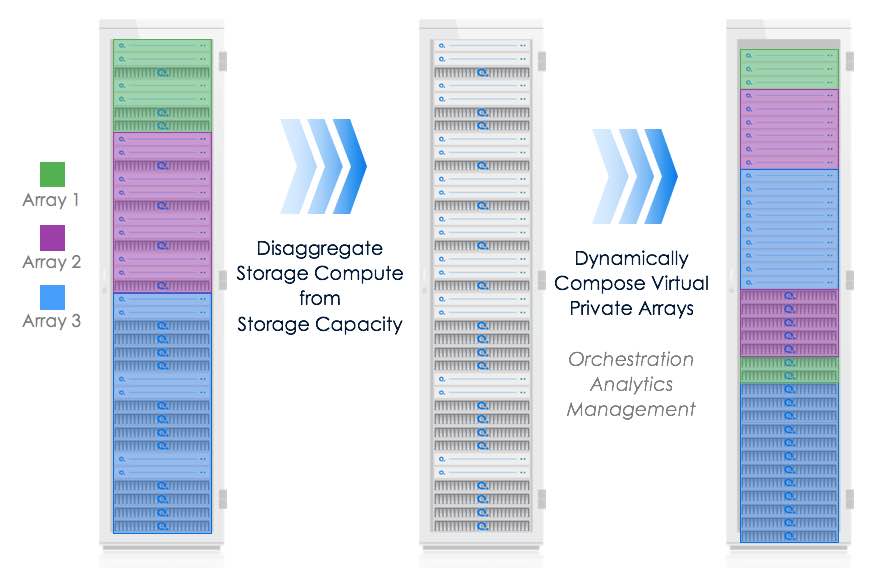
Kaminario decided to take a new route by disaggregating the hardware from the software and then handing over the hardware part to someone who already sells millions of hardware units all around the globe. Now, when you buy a Kaminario storage array, you get exactly the same physical appliance, but you (or your reseller) actually buy the hardware from Tech Data at commodity component cost. You then buy a consumption-based license to use the software from Kaminario based on the number of terabytes of data stored. This can be on a monthly Pay As You Go model or via a pre-paid subscription for a number of years. In a real sense, it is the cloud consumption model for people who require on-prem infrastructure.

There are all sorts of benefits to this (most customers never fill their storage arrays above 80% capacity, so why always pay for 100%?), but I’m not going to delve into them here because this is not a sales pitch, it’s an explanation for what I did next.

What I Did Next

Seeing as Kaminario decided to make a momentous shift, I thought it was a good time to make one of my own. So, two years ago, I took the decision to leave the world of technical presales and become a software sales executive. As in, a quota-carrying, non-technical, commercial sales guy with targets to hit and commission to earn. Presales people also earn commission, but are far more protected from the “lumpy” highs and lows that come with complex and lengthy high-value sales cycles (what sales people call “big ticket sales”). In commercial sales, the highs are higher and the lows are lower – and the risks are definitely riskier. Since my new role coincided with the company going through an entire change of business model, the risk was pretty hard to quantify, but I’m pleased to say that 2018 was the company’s best ever year, not just globally but also in the territory that I now manage (the United Kingdom).

More importantly for me, I’m now two years into this new journey and I have zero regrets about the decision to leave my technical past behind. I’ve learnt more than ever before (often the hard way) and I’ve experienced all the highs and lows one might expect, but I still get the same excitement from this role that I used to get in the early days of my technical career.

So, the time is right to hang up the technical jersey and bid flashdba farewell. It’s been fun and I want to say thank you to everybody who read, commented, agreed or disagreed with my content. There are almost 200 posts and pages on this site which I will leave here in the hope that they remain useful to others – and as a sort of virtual monument to my former career.

In the meantime, I’ve got to go now, because there are meetings to be had, customers to be entertained, dinners to be expensed and (hopefully) deals to be closed. Farewell, my friends, stay in touch… and remember, if you need to buy something… call me, yeah?

— flashdba —

[September 2020 Spoiler Alert: I couldn’t stay away]

Flash Debrief: The End (part 1)

Seven years ago this month, I created a blog and online presence called flashdba to mark the start of my journey away from Oracle databases (and DBAing) into the newly-born All-Flash Storage industry. Six years ago this month, I posted the first in what transpired to be a very long blog series attempting to explain the concepts of All Flash to those few who were interested. At least, I always assumed it would be a few, but now here we are in 2019 and the flashdba.com blog has been read over a million times, referenced in all sorts of surprising places and alluded to by Chris Mellor at The Register. One of my articles even (allegedly) got a mention by Mark Hurd during an Oracle forecast call!

But now, for various reasons that I will explain later, it’s time to draw it to a conclusion.

Review

Wow! What a ride it’s been, huh? Seven years ago, I joined a company called Violin Memory who were at the forefront of the infant (or should that be infantile?) flash industry. At one point, Violin had a global partnership with HP to make an “Exadata-killer” machine and had a valuation estimated to be around $2bn. EMC even wrote a secret briefing document in which they said, “Violin … is XtremIO’s #1 competitor in the all-flash storage market”. Meanwhile, numerous other small flash companies were being acquired for ridiculous, crazy and obscene money despite often being “pre-product” or pre-GA.So it took a particularly special effort for Violin Memory to take that head start and end up in Chapter 11 bankruptcy in December 2016. (The company is reborn as Violin Systems now, of course – and I still have friends there, so out of respect for them I have to keep my Violin stories under wraps. Which is a shame, because boy do I have some great stories…)divorce

Meanwhile, back in 2015, I’d decided to leave Violin Memory and join another All Flash pioneer, Kaminario – where I remain today. It’s fair to say that Violin Memory didn’t appreciate that decision, with the result that I had to spend a lot of time dealing with their lawyers. You feel very small when you are a sole person engaged in a legal dispute with a corporation who can afford an expensive legal team – you become enormously aware of the difference in spending power (although, in hindsight, perhaps Violin could have used those legal fees elsewhere to better effect). So, when the CEO of Kaminario interrupted his family holiday to call me and assure me that they would stand by me throughout the dispute, it left me with a real glimpse into the different in culture between my former employer and my current one. Also, Kaminario’s lawyers were a lot better!

The Flash Storage Wars (available now as a boxset)

The road from 2012 to 2019 is littered with the bloody carcasses of failed flash companies. From the disasters (Violin Memory, Skyera, FusionIO, Tintri, Whiptail, DSSD) to the acquisitions (Texas Memory Systems, XtremIO, Virident, SolidFire, Nimble) – not all of which could be considered successful – to the home-grown products which never really delivered (I’m looking at you, Oracle FS1). One company, Pure Storage, managed to beat the odds, ride out some stormy times and go from startup to fully-established player, although following their IPO the stock market has never really given them a lot of love. Meanwhile, EMC – the ultimate big dog of storage – was acquired by Dell, while HP split into two companies and NetApp continued to be linked with an acquisition by Lenovo or Cisco. Someday, somebody is going to turn the whole story into a boxset and sell it to Netflix for millions. Game of Thrones eat your heart out.

Yet there can be no doubt that All Flash itself has succeeded in its penetration of the previously disk-dominated enterprise storage market, with IDC regularly reporting huge year-on-year growth figures (e.g. 39.3% between Q3-2017 and Q4-2018). I vividly remember, back in 2012, having to explain to every prospective customer what flash was and why it was important. Today, every prospect has already decided they want All Flash. In fact, AFAs have become so mainstream now that, starting this year, Gartner will be merging its Solid State Array Magic Quadrant with the more traditional MQ for General-Purpose Disk Arrays. It just doesn’t make sense to have two separate models now.

So Who Won?

Good question. Was it DellEMC, the biggest company in storage and the current #1 in market share? Was it Pure Storage, who led Gartner’s most recent Solid State Array Magic Quadrant (but have it all to lose when the SSA MQ merges with the general-purpose MQ)? Or was it any number of investors and venture capitalists who managed to make money on the back of such market disruption? It’s a subjective question so you can choose your own answer. But for me, it’s very clear that there was only one winner… and back in 2012 we had no idea (although my old boss called it over a decade ago… I should have paid more attention). The ultimate winner of this war – and many other wars besides – is the cloud.

In part two – the final ever blog in this series (and possibly at all – spoiler alert), I’ll explain why I think the cloud is the ultimate winner… and why I’m calling time on flashdba after all these years. Wipe away those tears, my friends – not long now.

See also: this article apparently inspired the highly respected storage-industry journalist Chris Mellor to write A Potted History of All-Flash Arrays over at Blocks and Files. Thanks Chris, I’m honoured!