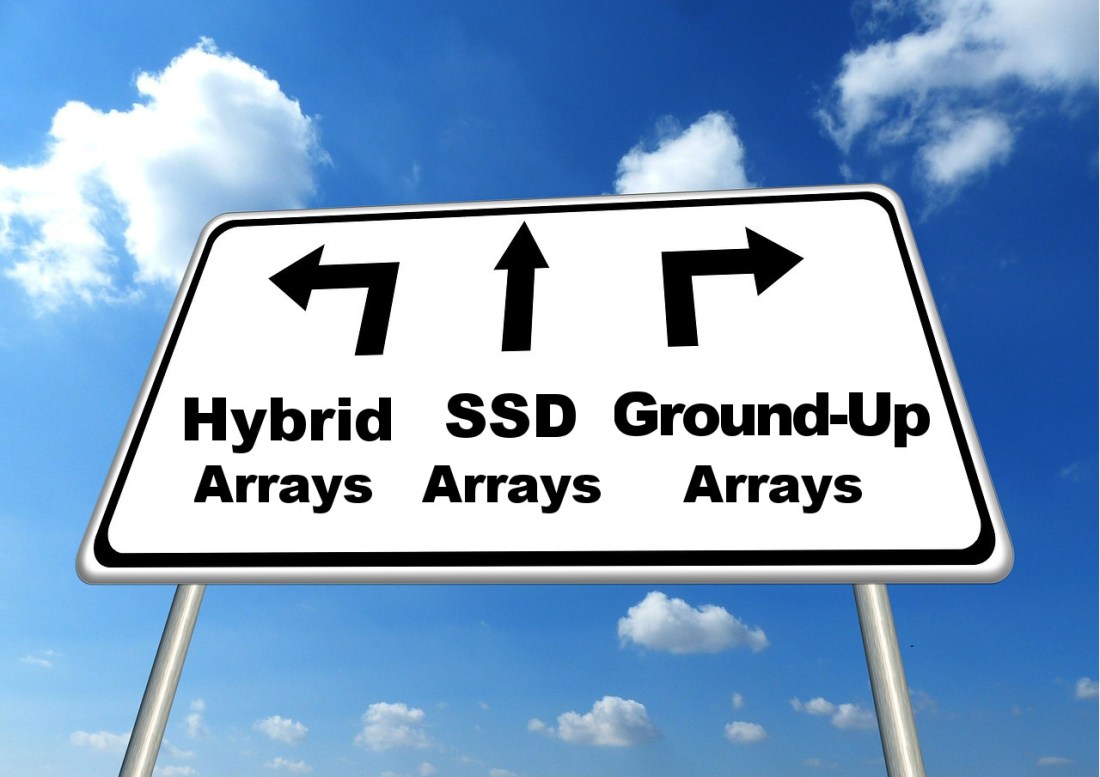
Filling a legacy disk array with SSDs doesn't make it a true all flash array. This article builds a disk array from first principles to show why every architectural decision made for disk turns out to be the wrong one for flash.
Category: Storage
Storage is the foundation on which database performance is built. Latency, throughput, and consistency at this layer directly shape how systems behave under load.
While often abstracted away in modern architectures, storage characteristics continue to define the limits of what databases can achieve – especially as workloads become more demanding and less predictable.
Oracle’s ASM Filter Driver Revisited
Almost exactly a year ago I published a post covering my first impressions of the ASM Filter Driver (ASMFD) released in Oracle 12.1.0.2, followed swiftly by a second post showing that it didn't work with 4k native devices. When I wrote that first post I was about to start my summer holidays, so I'm afraid … Continue reading Oracle’s ASM Filter Driver Revisited
All Flash Arrays: What Is An AFA?
All flash arrays come in three distinct categories: hybrid, SSD-based and ground-up designs. This article explains the differences, cuts through competing industry definitions from IDC and Gartner, and sets out a clear definition for what actually qualifies as an AFA.
Was I Mentioned During Oracle’s Q4 2015 Results Call?
In a proud moment for me, it appears that Mark Hurd, CEO of Oracle, has mentioned my flashdba blog during the Oracle Q4 2015 results call. At least, that's what I'm reading into this section from the transcript published by Seeking Alpha: We grew in storage in the quarter and this is -- really we are … Continue reading Was I Mentioned During Oracle’s Q4 2015 Results Call?
Understanding Flash: Summary – NAND Flash Is A Royal Pain In The …
NAND flash is a genuinely difficult storage medium – it wears out, has slow erases, and requires complex management. This article summarises the Understanding Flash series and explains why architecture is what separates great all-flash arrays from merely fast ones.
The Great Hypervisor Bake-off: VMware ESX vs Oracle VM
This is a very simple post to show the results of some recent testing that my colleague and I ran using Oracle SLOB on Violin to determine the impact of using virtualization. But before we get to that, I am duty bound to write a paragraph of text featuring lots of long sentences peppered with industry … Continue reading The Great Hypervisor Bake-off: VMware ESX vs Oracle VM
ASM Rebalance Too Slow? 3 Tips To Improve Rebalance Times
I've run into a few customers recently who have had problems with their ASM rebalance operations running too slowly. Surprisingly, there were some simple concepts being overlooked - and once these were understood, the rebalance times were dramatically improved. For that reason, I'm documenting the solutions here... I hope that somebody, somewhere benefits... 1. Don't … Continue reading ASM Rebalance Too Slow? 3 Tips To Improve Rebalance Times
Implementing Linux native multipathing or DM-MPIO together with EMC PowerPath
Guest Post I'm delighted to say that this is another guest post from my good friend Nate Fuzi, who performs the same role as me for Violin but is based in the US instead of EMEA. Because he is American, Nate thinks that scones are called "biscuits", that chips are called "fries" and that there is … Continue reading Implementing Linux native multipathing or DM-MPIO together with EMC PowerPath
Postcards from Storageland: Three Years At Violin
A few weeks ago, in what seems to be a truly modern phenomenon, I became aware that it was my third anniversary of joining Violin after I noticed a number of people congratulating me on LinkedIn. In many ways it feels like I've already been here for a lifetime, but it was only twelve months ago … Continue reading Postcards from Storageland: Three Years At Violin
Understanding Flash: Fabrication, Shrinkage and the Next Big Thing
NAND flash manufacturers have been shrinking transistors for decades, but 2D planar NAND is hitting its physical limits. This article explains process geometries, 3D NAND as the answer, and why new memory technologies face a billion-dollar barrier to market.